
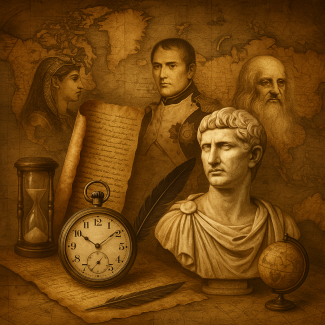
Fascinating Historical Facts You Didn't Learn in School
Discover mind-blowing history facts that most people have never heard
History isn’t just a dusty archive of dates and dead kings—it’s a living collection of unbelievable stories, power struggles, bizarre coincidences, and everyday moments that shaped our world. And while most people know about the pyramids, World Wars, or the fall of the Roman Empire, countless lesser-known events and surprising twists lurk just outside the margins of mainstream education.
This article will take you on a journey through some of the most fascinating, unexpected, and thought-provoking pieces of history trivia that will challenge what you think you know—and leave you hungry for more.
Why historical trivia is more exciting than you think
Let’s face it: when most people hear the word "history," their mind flashes back to memorizing battle dates or trudging through thick textbooks. But history trivia breaks the mold. It cuts straight to the juicy details—the forgotten facts, quirky human moments, and strange turns of fate that textbooks often leave behind.
Why did Napoleon sell the Louisiana Territory for a bargain? How did a pigeon become one of World War I’s most decorated war heroes? Which medieval king died because of a bad chair?
These aren't just fun facts—they’re windows into humanity’s untamed past, revealing just how weird, brilliant, and unpredictable our story really is.
Strange history facts that sound made up—but aren’t
You might think you’ve got a good grip on the past, but history has a funny way of hiding its most bizarre moments in the footnotes. Consider these examples:
- The Great Emu War of 1932 saw the Australian military lose a “war” against giant flightless birds—yes, emus. The birds outran soldiers and dodged bullets so effectively that humans surrendered.
- President John Tyler, born in 1790, still has two living grandsons today. That’s right—grandsons, not great-great-grandchildren.
- Cleopatra lived closer to the invention of the iPhone than to the building of the Great Pyramid. She ruled around 30 BCE; the pyramid was built over 2,000 years earlier.
Each of these snippets is a reminder that truth is often stranger than fiction, and the more we dig, the more deliciously odd the past becomes.
What makes a great piece of history trivia?
Not all trivia is created equal. The best kind:
- Reveals something you wouldn’t expect
- Connects to a broader historical theme
- Sparks an “aha!” moment or an emotional reaction
- Makes you see the present in a new light
The most memorable trivia sticks because it interrupts what we thought we knew, offering a new perspective or a story that feels oddly relevant today.
The joy of discovering hidden stories from history
Part of what makes unusual historical facts so compelling is that they cut through the clutter. One strange royal decision, one wartime mix-up, or one overlooked invention can shift your whole view of a period. Take for example:
- The defenestrations of Prague—actual political assassinations carried out by throwing people out of windows.
- The time when a single vote in 1800 tied Thomas Jefferson and Aaron Burr for the presidency, throwing the U.S. government into chaos.
- Or the reality that pirates had workers’ comp policies centuries before most modern governments.
These stories make history feel alive—less like a set of names on a timeline and more like a dramatic, absurd, all-too-human saga.
Why you'll love diving into the world of history trivia
If you’ve ever felt a thrill reading about ancient curses, mysterious disappearances, or unlikely historical chain reactions, you’re not alone. History trivia scratches that deep itch for wonder, surprise, and connection.
It’s the joy of realizing that:
- People across centuries weren’t so different from us—they made mistakes, had egos, held grudges, and told tall tales.
- Our world today is shaped by a tangled web of strange coincidences, unsung heroes, and forgotten disasters.
- There’s always more to learn, always another secret waiting to be uncovered.
Whether you’re a casual browser or a lifelong history nerd, this topic invites you to see the past with fresh eyes, question what you know, and collect stories that are guaranteed to impress at your next dinner party.
What makes history trivia so addictive?
In a world filled with endless scrolls and rapid-fire news, history trivia offers something uniquely satisfying: bite-sized knowledge with surprising depth. You can learn about a 15th-century duel that lasted over six months or the Mongol postal system that rivaled Amazon Prime—and suddenly the modern world seems less original than we thought.
Our fascination with historical oddities isn’t just about facts—it’s about story. It’s about discovering a truth that makes you pause, smile, laugh, or even gasp. It’s a reminder that reality is full of plot twists, and the human race has always been a little unpredictable.
So if you're the kind of person who loves to say, “Did you know…?”—you’ve found your people.
We’d love to hear: What’s the strangest history fact you've ever come across? Share it, tag a trivia lover, or just keep it in your back pocket for your next trivia night.
30 unbelievable history trivia questions with answers to challenge your knowledge
Thought-provoking questions about world history events and people
- Which U.S. president had a pet alligator that lived in the White House bathroom?
Answer: John Quincy Adams. The alligator was a gift from Marquis de Lafayette. - What ancient city was buried under volcanic ash for over 1,500 years before being rediscovered?
Answer: Pompeii, destroyed in 79 AD by the eruption of Mount Vesuvius. - Who was the first woman to win a Nobel Prize—and the only person to win in two different sciences?
Answer: Marie Curie. She won in Physics (1903) and Chemistry (1911). - Which war lasted only 38 minutes, making it the shortest in recorded history?
Answer: The Anglo-Zanzibar War of 1896. - What was the original purpose of the Eiffel Tower when it was constructed in 1889?
Answer: It served as the entrance arch to the 1889 World’s Fair in Paris. - Which revolutionary figure was actually born on Corsica just months after it became French territory?
Answer: Napoleon Bonaparte. - Who was the youngest person ever to assume the office of President of the United States?
Answer: Theodore Roosevelt, at age 42, after President McKinley was assassinated. - Which famous document begins with “When in the Course of human events…”?
Answer: The Declaration of Independence. - What was the name of the ship on which the Pilgrims traveled to North America in 1620?
Answer: The Mayflower. - What major Cold War event involved the installation of Soviet missiles in Cuba?
Answer: The Cuban Missile Crisis of 1962.
Weird historical facts you probably didn’t know before
- Who was the real-life pirate that inspired the character of Captain Jack Sparrow?
Answer: Bartholomew Roberts, a flamboyant and disciplined pirate known for his strict code. - Which ancient civilization invented the first known system of writing?
Answer: The Sumerians, with their cuneiform script. - Which famous leader reportedly never lost a battle and conquered more territory than anyone else in history?
Answer: Genghis Khan. - Who was the first U.S. president to appear on television?
Answer: Franklin D. Roosevelt, during the opening of the 1939 World’s Fair. - What civilization built Machu Picchu high in the Andes Mountains?
Answer: The Inca Empire. - Which country gifted the Statue of Liberty to the United States in 1886?
Answer: France. - What everyday item did the ancient Egyptians use as early toilet paper?
Answer: Soft papyrus sheets. - Which monarch reigned over Britain for the longest time before Queen Elizabeth II surpassed the record?
Answer: Queen Victoria, who reigned for over 63 years. - Which battle marked the end of Napoleon’s reign as emperor of France?
Answer: The Battle of Waterloo in 1815. - What famous wall stretches over 13,000 miles and was originally built for defense?
Answer: The Great Wall of China.
Fun history trivia that will impress your friends
- What was Leonardo da Vinci's profession besides being a painter?
Answer: He was also an engineer, anatomist, architect, and inventor. - Who wrote the ancient medical text “The Canon of Medicine,” widely used for centuries?
Answer: Avicenna (Ibn Sina), a Persian polymath. - Which 20th-century conflict lasted the longest for the United States in terms of active combat operations?
Answer: The Vietnam War. - What invention by Johannes Gutenberg revolutionized the spread of knowledge in Europe?
Answer: The printing press. - Which ancient wonder of the world was located in modern-day Iraq?
Answer: The Hanging Gardens of Babylon. - Which year marked the fall of the Berlin Wall and the symbolic end of the Cold War?
Answer: 1989. - What disease killed an estimated 25 million people in Europe in the 14th century?
Answer: The Black Death, or bubonic plague. - Who was the only U.S. president to serve more than two terms?
Answer: Franklin D. Roosevelt, elected to four terms. - Which European city served as the capital of the Holy Roman Empire for centuries?
Answer: Vienna, Austria. - What African kingdom was once so wealthy that its ruler's pilgrimage bankrupted neighboring economies?
Answer: The Mali Empire under Mansa Musa.
What these trivia questions reveal about how we understand the past
History trivia helps us view historical figures in a human light
While textbooks often portray leaders, inventors, and revolutionaries as distant icons, trivia uncovers their personal quirks and unexpected legacies. Knowing that Napoleon was terrified of cats or that da Vinci never finished most of his projects gives us a new, relatable understanding. These facts ground major historical figures in reality, showing that their impact was often shaped by human habits, impulses, and mistakes.
Small facts highlight big moments in human development
Learning that Gutenberg’s printing press could produce over 200 pages an hour, or that Cleopatra spoke nine languages, reframes our view of innovation and leadership. These bite-sized historical insights show how single inventions or unique talents shifted the course of entire civilizations. They're not just facts—they’re turning points that deserve a spotlight.
Fascinating trivia bridges entertainment and education
What makes history trivia so powerful is its dual appeal: it entertains while delivering deep insight. Behind every quirky question is a broader lesson about empire, survival, ideology, or culture. From the chaos of the Anglo-Zanzibar War to the philosophical depth of ancient Persia, each moment of trivia offers a portal into the greater human story—in just a few sentences.
Whether you’re using these facts to win a game night, spark a conversation, or simply enjoy a moment of wonder, they prove one thing: history is never boring—it’s just waiting to be told the right way.
Loved this dive into history’s best-kept secrets? Pass it on to a fellow trivia buff or drop your favorite historical oddity into the mix.